
 3
3 0
0Title:
Phospholipid assembly based artificial cells and their collective behaviors
Astract:
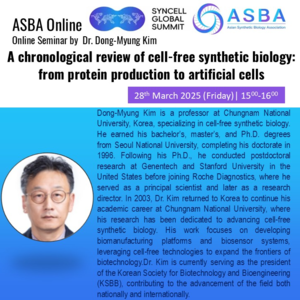
Cell-free synthesis technology was initially developed as an alternative platform for protein production, overcoming the limitations of cellular expression systems. By bypassing constraints such as cell viability, toxicity, and membrane permeability, cell-free protein synthesis has enabled the efficient production of a wide range of proteins, including those that are difficult to express in living cells. Over time, the scope of cell-free systems has expanded beyond protein synthesis, evolving into a powerful tool for cell-free metabolic engineering, where complex biosynthetic pathways can be constructed and optimized in a controlled, cell-free environment. More recently, cell-free systems have been integrated into synthetic cell engineering, where biochemical reactions are encapsulated within artificial compartments to mimic cellular functions and create programmable synthetic cells.In this presentation, he will provide a chronological review of the development of cell-free synthetic biology, tracing its progression from a protein synthesis platform to a versatile system for metabolic pathway engineering and, ultimately, the construction of artificial cells. By highlighting key advancements and applications, this talk will explore how cell-free systems are shaping the future of biomanufacturing, biosensing, and synthetic cell design.
Personal Profile:
Dong-Myung Kim is a professor at Chungnam National University, Korea, specializing in cell-free synthetic biology. He earned his bachelor’s, master’s, and Ph.D. degrees from Seoul National University, completing his doctorate in 1996. Following his Ph.D., he conducted postdoctoral research at Genentech and Stanford University in the United States before joining Roche Diagnostics, where he served as a principal scientist and later as a research director. In 2003, Dr. Kim returned to Korea to continue his academic career at Chungnam National University, where his research has been dedicated to advancing cell-free synthetic biology. His work focuses on developing biomanufacturing platforms and biosensor systems, leveraging cell-free technologies to expand the frontiers of biotechnology.Dr. Kim is currently serving as the president of the Korean Society for Biotechnology and Bioengineering (KSBB), contributing to the advancement of the field both nationally and internationally.
