

 0
0 0
0Title:
Construction and Evolution of an Escherichia coli Strain Relying on Non-oxidative Glycolysis for Sugar Catabolism
Astract:
The Embden-Meyerhoff-Parnas (EMP) pathway, commonly known as glycolysis, represents the fundamental biochemical infrastructure for sugar catabolism in almost all organisms, as it provides key components for biosynthesis, energy metabolism, and global regulation. EMP-based metabolism synthesizes three-carbon (C3) metabolites prior to two-carbon (C2) metabolites, and must emit one CO2 in the synthesis of the C2 building block, acetyl-CoA, a precursor for many industrially important products. Thus, a key limitation for producing acetyl-CoA derived bioproducts is the intrinsic carbon loss in acetyl-CoA biosynthesis. Pyruvate decarboxylation releases the carboxyl group of pyruvate as carbon dioxide or formate to the environment. To overcome this limitation, they constructed and evolved an E. coli strain that relies on non-oxidative glycolysis (NOG) for carbon catabolism to support growth. In this talk, Dr. Paul Lin will discuss how the fundamental metabolic pathways can be re-wired and how regulatory circuits can be altered through rational design, genome editing and evolution.
Personal Profile:
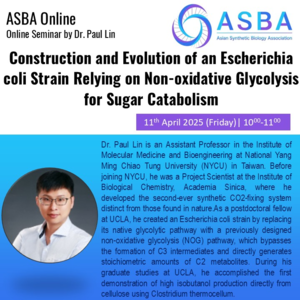
Dr. Paul Lin is an Assistant Professor in the Institute of Molecular Medicine and Bioengineering at National Yang Ming Chiao Tung University (NYCU) in Taiwan. Before joining NYCU, he was a Project Scientist at the Institute of Biological Chemistry, Academia Sinica, where he developed the second-ever synthetic CO2-fixing system distinct from those found in nature.As a postdoctoral fellow at UCLA, he created an Escherichia coli strain by replacing its native glycolytic pathway with a previously designed non-oxidative glycolysis (NOG) pathway, which bypasses the formation of C3 intermediates and directly generates stoichiometric amounts of C2 metabolites. During his graduate studies at UCLA, he accomplished the first demonstration of high isobutanol production directly from cellulose using Clostridium thermocellum.
