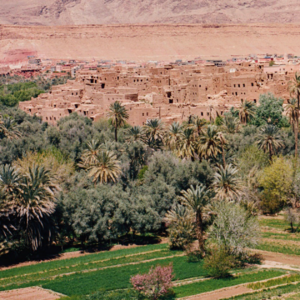
The Critical State of Oases: The document starkly portrays the vanishing nature of oases, using evocative language and examples. The Tanoueest Oasis, once lush, is now "overrun by sand," and the Drâa River, Morocco's longest, flows through Mhamid el Ghizlane as a "dry riverbed of sand and gravel." Halim Sbai, a longtime resident, notes how the oasis has "shrivelled as the rain has all but stopped and the river has dried up."
The Impact of Climate Change: The excerpts explicitly link the decline of oases to climate change. Temperatures are projected to rise significantly, and rainfall is expected to decrease drastically. The text also highlights the increase in "destructive floods and wildfires," with government figures showing "around 10,000 palm trees burn every year."
The Oasis Ecosystem and the Date Palm: The article emphasizes the ecological definition of an oasis as "simply an area made fertile by a water source in an otherwise harsh and arid environment," but quickly highlights how "human ingenuity has transformed oases into complex civilizations." The date palm is identified as a "keystone species" and described by Professor Mohamed Ait-El-Mokhtar as "the umbrella" under which a three-tiered agricultural system thrives. He states, "'If we want to sustain this structure in the oasis, we have to sustain the date palm.'"
Unsustainable Water Management: The negative consequences of uncontrolled groundwater pumping are a significant focus. While solar pumps are "cheap to run and make extracting water easy," they are described as a "short-term fix" that can "very quickly kill the oasis." The increase in "soil salinity" and the lowering of the water table are highlighted as direct results. Farmer Abdelkarim Bannaoui illustrates this with his own experience, having to dig his well significantly deeper over the years.
The Feedback Loop of Migration and Desertification: The document details how the exodus of young people directly contributes to the oasis's deterioration. As the "local population has fallen by a fifth in the past 20 years," the aging residents struggle to maintain the infrastructure. Neglected plots and unmaintained irrigation channels become vulnerable to the encroaching sand, leading to "soil degradation" and buildings being "reclaimed by the desert."
Blending Ancient Knowledge and Modern Innovation: Halim Sbai is presented as a central figure in the efforts to save the oasis. He champions the integration of traditional nomadic principles of sharing and community resource management with modern techniques like "drip-fed irrigation" and the use of "Waterboxxes" for young saplings. His lobbying efforts to replace private solar pumps with "community solar pumps and wells" embody this approach, aiming for water to be "managed communally and shared equitably," reflecting the nomadic principle: "'In nomadic culture,' he says, 'you need to share everything.'"
The Importance of Cultural Preservation: The Joudour Sahara music school is presented as a direct response to the challenge of retaining young people. Thomas Duncan, co-founder, explains the motivation: "'We asked, What can you offer young people to make them stay?'" The school's focus on traditional music and culture aims to build pride and connection to the oasis.
Sustainable Architecture: The new Joudour Sahara cultural center exemplifies the blend of tradition and innovation in architecture. Designed by Aziza Chaouni, it utilizes "traditional rammed-earth buildings" but with modern design elements and infrastructure like an underground cistern for collecting and storing rainwater. Chaouni's goal was "to build pride in traditional architecture, not to just copy the past but be innovative."
The Value of Nomadic Culture: Sbai repeatedly emphasizes the importance of nomadic culture's principles of living within nature's constraints, sharing resources, and avoiding waste as essential for the oasis's survival.
Rethinking Tourism: The document raises questions about the type of tourism that is beneficial to the oasis, contrasting unsustainable practices with a "slower and simpler" approach that "treads more lightly on the land" and draws on local culture and history.


 30
30 0
0