
 3
3 0
0China's great delivery war
Food, medicine, groceries, if it fits on a scooter, is part of the great delivery war.
Tech titans such as JD.com and Alibaba are storming into Meituan and Ulema's territory with blazing fast delivery promises and billion yuan subsidies.
But in a mature market where every minute counts, who's fast enough and fierce enough to come out the winner?
Behind the flurry of scooters and app notifications lies something bigger.
The essence of instant retail is quietly rewriting the relationship between people, goods, and the spaces where e-commerce happens in China.
What used to be a model of planned purchases and patient delivery has rapidly evolved into a system built for impulse, immediacy, and proximity.
As tech giants such as JD.com and Alibaba push into Meituan and Ulema's强hold, these are platforms that build their empires on food delivery and local services.
It's clear this is no longer just about food.
It's about a new infrastructure of urban life in China.
This is a war for your doorsteps, folks who live in China.
And no one wants to be left behind the delivery bag holding the delivery bag, so to speak.
So what's happening in the delivery world in China right now?
I mean, let's look back at the past over 10 years.
China's food delivery market has already been a near dual poly of sorts.
That's dominated by Meituan, which is a leading lifestyle platform here in China, and also Ulema, that's a delivery system owned by tech giant Alibaba.
And these two alone, they together controlled over 90% of the market as of 2023, according to an industry analyzing report.
So Meituan, the yellow one, grew its market share from 30% in 2014 to over 65% by 2023.And Ulema, the blue one, held around 33%.
And the market itself balloon ed to 1.64 trillion yuan, that roughly equals to 230billion U. S. dollars by 2024, and is projected to be nearly 2 trillion yuan, or roughly280 billion U. S. dollars by 2027.
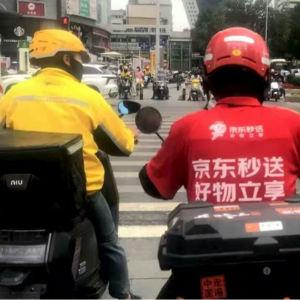
So when we look at this whole market, we' re talking about all of the deliveries sentout by the deliverers, or what we call the riders here in China, because they' realways on their e- bikes with a huge box containing the food that they' re delivering.So these people, they' re the freelance couriers, or riders, that's hired via third- partylabor agencies, with relatively less social benefits or protections due to the gig, orsay part- time nature of this job.
So that's how it's like right now in China with the delivery market.
Yeah, and there's a lot of pressure on these delivery drivers to do it quickly, andthey' re under tight time schedules.
And when you live here in Beijing, and I'm sure this is true for other cities here inChina as well, you see these riders everywhere, every day, all the time.
JD.com or JD Jingdong has entered the chat and it wrecked havoc earlier or actuallyin the later part of February.
Is that something like that? Right. In recent months.
Yeah. Around the beginning of 2025. Right. Exactly.
And most recently, it is Taobao that is joining the chat as well.
So could you kind of walk us through this heated battle that's been going on thisworld in the last few months?
So we just mentioned how the Taobao flash was launched in late April.
And just within 48 hours after it was launched, well, Olima, the delivery systemthat's based on the same company, saw delivery orders reaching new highs across13 cities.
Tencent, the huge tech company, is behind Meituan.
So now in China, when you look at e- commerce, and here instant deliveryparticularly, you can see that this is a mature market.
It's all the big players, the major tech industry players, they are behind thesecompanies.
And to this point, it's difficult to even fathom that a nobody little potato can growout of the field anymore because everything's so established.
And it's also interesting to see that why JD, Jingdong, who's also a huge techcompany, wants to get into this.
It knows that it's going to sort of ruffle some wrong feathers, and it's going to startthe dust.
And when you look at the Chinese tech scene, the e- commerce scene, it's now maybepast the teenager growth period.
It's now very mature.
So for me, as a casual observer, I just find it to be interesting, or like I don't work inthe industry, but I just find it, why now?
Well, because it's a huge market.
This is a $230 billion industry in 2024, and they expect that to be a $280 billionindustry by 2027.
I'm no expert business person, but that seems like a pretty good reason to getinvolved in the market, I would sa
But also, I think you guys mentioned a very important point, too, because thesecompanies, they' re also trying to break through from their traditional e- commercebusiness model as well.
