

 0
0 0
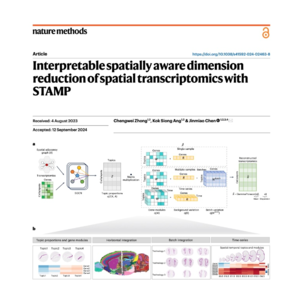
0This article from Nature Methods detailing a new computational method called STAMP (Spatial Transcriptomics Analysis with topic Modeling to uncover spatial Patterns), which is designed for the analysis of spatial transcriptomics data. STAMP is an interpretable, spatially aware dimension reduction method that utilizes a deep generative model to identify biologically relevant, low-dimensional spatial "topics" and associated gene modules. The authors demonstrate that STAMP outperforms competing dimension reduction and clustering algorithms across various datasets, including mouse hippocampus, human lung cancer, and time-series mouse embryo development, excelling in tasks like discovering anatomical structures, integrating multi-sample data, and correcting for batch effects across different technologies. Overall, the method aims to provide scalable, robust, and interpretable insights into the complex spatial organization of gene expression within tissues.
References:
- Zhong C, Ang K S, Chen J. Interpretable spatially aware dimension reduction of spatial transcriptomics with STAMP[J]. Nature Methods, 2024, 21(11): 2072-2083.
