

 2
2 0
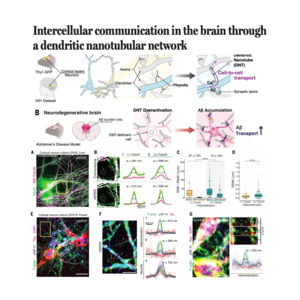
0This research article introduces the discovery and characterization of dendritic nanotubes (DNTs), a previously unconfirmed nonsynaptic communication network in the brain that operates in parallel with traditional synapses. Using advanced microscopy on mouse and human brain tissue, the authors identified these ultrathin membrane bridges, which are formed by dendritic filopodia and confirmed to facilitate the intercellular transfer of substances like calcium ions. Crucially, the study demonstrates that DNTs act as direct conduits for the propagation of disease-related molecules, specifically human beta-amyloid (Aβ) peptides implicated in Alzheimer’s disease (AD). Computational models and experiments in AD mouse models suggest that an altered DNT network in early pathology accelerates the toxic accumulation of Aβ in certain neurons, revealing a new mechanism for the spread of neurodegeneration.
References:
- Chang M, Krüssel S, Parajuli L K, et al. Intercellular communication in the brain through a dendritic nanotubular network[J]. Science, 2025, 390(6768): eadr7403.
