
 12
12 0
0Title:
Tackling the global spread of AMR using genome-resolved metagenomics and AI
Astract:
We live in a microbial world (≈1 million species), but humanity’s adversarial microbial relationship comes from a few pathogens and widespread antimicrobials. Microbe eradication often fails—disinfected areas recolonize fast, and antibiotics fuel resistant pathogens. Global antimicrobial resistance (AMR) in common pathogens (e.g., ESKAPE) threatens healthcare; as effective antibiotics shrink, some pathogens may become untreatable, endangering millions of hospital patients. AMR already causes >1 million annual deaths, with the UN projecting it will surpass all cancers (>10 million/year) by 2050. New methods are needed to track AMR transmission and use ecology to reduce AMR reservoirs. Long-read sequencing-aided genome-resolved metagenomics can transform microbial surveillance, as seen in hospital and gut pathogen tracking. To understand microbial community assembly and pathogen resistance, new AI/modelling tools (using high-throughput metagenomic data) provide mechanistic insights. Combined with data mining, these help study microbiome recovery from antibiotics and develop new biotherapeutics to stop AMR pathogen spread.
Personal Profile:
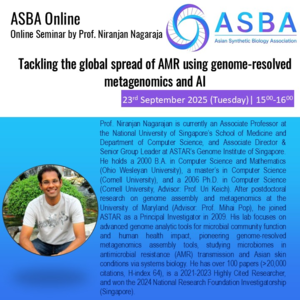
Prof. Niranjan Nagarajan is currently an Associate Professor at the National University of Singapore’s School of Medicine and Department of Computer Science, and Associate Director & Senior Group Leader at ASTAR’s Genome Institute of Singapore. He holds a 2000 B.A. in Computer Science and Mathematics (Ohio Wesleyan University), a master’s in Computer Science (Cornell University), and a 2006 Ph.D. in Computer Science (Cornell University, Advisor: Prof. Uri Keich). After postdoctoral research on genome assembly and metagenomics at the University of Maryland (Advisor: Prof. Mihai Pop), he joined ASTAR as a Principal Investigator in 2009. His lab focuses on advanced genome analytic tools for microbial community function and human health impact, pioneering genome-resolved metagenomics assembly tools, studying microbiomes in antimicrobial resistance (AMR) transmission and Asian skin conditions via systems biology. He has over 100 papers (>20,000 citations, H-index 64), is a 2021-2023 Highly Cited Researcher, and won the 2024 National Research Foundation Investigatorship (Singapore).
