

 0
0 0
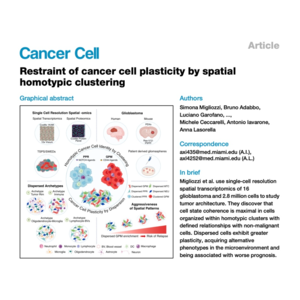
0The sources present a scientific article from Cancer Cell detailing research on glioblastoma (GBM) cell behavior, specifically examining how the spatial arrangement of tumor cells influences their identity and plasticity. Using advanced single-cell resolution spatial transcriptomics and proteomics, the study found that when GBM cells are organized in homotypic clusters, their cellular state is stable, while dispersed cells exhibit greater plasticity and acquire alternative, more aggressive phenotypes. The authors identified different adhesion mechanisms, such as CD44 and NOTCH signaling, that maintain these clusters and, critically, showed that the proportion of dispersed glycolytic/plurimetabolic (GPM) cells is uniquely associated with a worse prognosis in GBM patients, establishing a clinical significance for cancer cell spatial patterning. The study proposes that homotypic clustering acts as a general mechanism across different tumor types, like breast cancer, to restrain cell state diversity.
References:
- Migliozzi, Simona, et al. "Restraint of cancer cell plasticity by spatial homotypic clustering." Cancer cell (2025).
