

 0
0 0
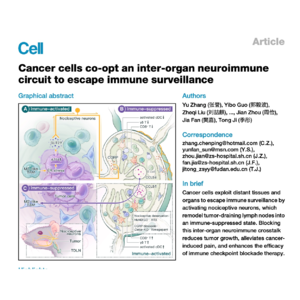
0This article investigates how cancer, specifically head and neck squamous cell carcinoma (HNSCC) and murine oral cancer models, utilizes a neuroimmune circuit involving distant organs to evade the immune system, thereby compromising the effectiveness of immune checkpoint blockade therapy. The research details a complex mechanism where cancer cells, under immune pressure, secrete a ligand (SLIT2) to activate nociceptive neurons, which subsequently remodel tumor-draining lymph nodes (TDLNs) into an immune-suppressed state. Through various advanced techniques like CyTOF, scRNA-seq, and optogenetics, the authors demonstrate how inhibiting this neuronal activity enhances anti-tumor immunity by increasing beneficial immune cells like $\text{CD8}^+$ T cells and activated dendritic cells in the TDLNs, suggesting that targeting this neuroimmune axis could be a promising therapeutic strategy.
References:
- Zhang Y, Guo Y, Liu Z, et al. Cancer cells co-opt an inter-organ neuroimmune circuit to escape immune surveillance[J]. Cell, 2025.
