

 0
0 0
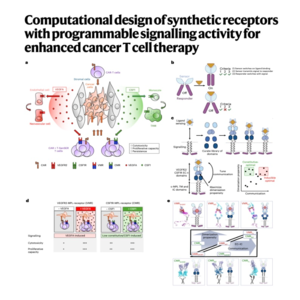
0The paper describes a study on developing synthetic receptors for enhancing CAR-T cell therapy against cancer. Researchers used a computational design platform to create allosteric switch receptors, named T-SenSERs, that respond to soluble factors in the tumor microenvironment (TME), specifically VEGFA or CSF1, with co-stimulation and cytokine signals. The goal is to overcome limitations of current CAR-T therapies, particularly in solid tumors, by providing context-dependent activation and boosting T cell persistence and anti-tumor function. Experimental validation in both lung cancer and multiple myeloma models demonstrated that combining CARs with these T-SenSERs (VMRFL and CMRFL) significantly enhanced anti-tumor activity in a ligand-dependent manner. This approach offers a novel framework for engineering cellular therapeutics with customized sensing and signaling responses.
References:
- Rath J A, Rudden L S P, Nouraee N, et al. Computational design of synthetic receptors with programmable signalling activity for enhanced cancer T cell therapy[J]. Nature Biomedical Engineering, 2025: 1-21.
