

 0
0 0
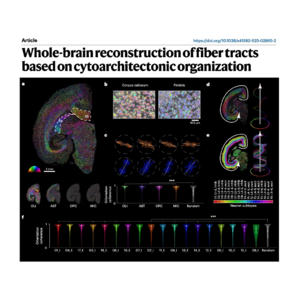
0The paper details the development of the Cytoarchitecture-Based Link Estimation (CABLE) method, a novel technique for reconstructing whole-brain fiber tracts using high-throughput fluorescence imaging at cellular resolution. This method determines fiber orientation by interpreting the inherent anisotropy of cell nuclei and somata and their precise spatial arrangement within the tissue. CABLE provides a significant advantage over existing methods, such as diffusion magnetic resonance imaging (dMRI), because it can accurately resolve complex intersecting or bending fibers that are otherwise difficult to map. The method was validated through detailed viral tracing in primate brains and applied successfully to detect fiber tract impairment in neonatal human brain tissues, establishing a new pathway for high-resolution anatomical mapping in health and disease.
References:
- Zhang Y, Song T, Yang C Y, et al. Whole-brain reconstruction of fiber tracts based on cytoarchitectonic organization[J]. Nature Methods, 2025: 1-10.
