

 3
3 0
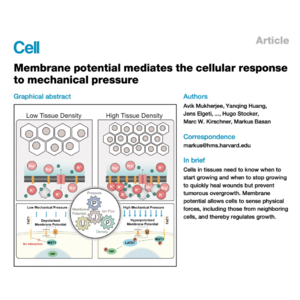
0The article explores the connection between mechanical forces, tissue density, and cellular growth control, establishing that membrane potential serves as a fundamental biophysical signal. The authors present a mechano-electro-osmotic model showing that compression leads to higher cytoplasmic biomass density, which physically couples to the cell membrane to induce hyperpolarization. Experimental results confirm that as epithelial tissues reach maximum density, cells become progressively more hyperpolarized and cease proliferation. This electrical signal directly regulates key growth pathways, as hyperpolarization causes the transcriptional co-activator YAP of the Hippo pathway to exit the nucleus, thereby suppressing growth. Conversely, depolarization speeds up wound healing by promoting growth factor activity and YAP nuclear re-entry. This mechanism provides an integrated, size-independent readout of mechanical pressure, which is essential for maintaining tissue homeostasis and preventing tumorous overgrowth.
References:
- Mukherjee A, Huang Y, Elgeti J, et al. Membrane potential mediates the cellular response to mechanical pressure[J]. Cell, 2025.
