

 5
5 0
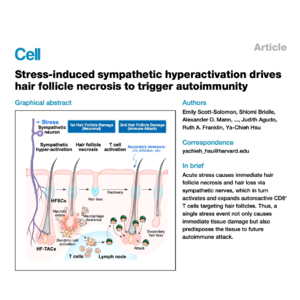
0The paper describes a two-part physiological and immunological mechanism by which acute stress damages hair follicles and triggers autoimmunity. Initially, acute stress causes the sympathetic nervous system to become hyperactivated, releasing excessive norepinephrine which induces a calcium surge that leads to necrosis—or uncontrolled death—of the highly proliferative hair follicle cells (HF-TACs). This immediate necrotic event is highly inflammatory, prompting antigen-presenting cells to capture the resulting cellular debris. Subsequently, this process leads to the activation and expansion of autoreactive CD8+ T cells that are specifically trained to target the hair follicle. Although the tissue recovers from the initial stress, the presence of these primed T cells leaves the body susceptible to future damage. Consequently, a secondary inflammatory trigger, such as an infection or UV exposure, can overcome peripheral tolerance and provoke a secondary, T cell-mediated autoimmune attack against the hair follicles.
References:
- Scott-Solomon E, Brielle S, Mann A O, et al. Stress-induced sympathetic hyperactivation drives hair follicle necrosis to trigger autoimmunity[J]. Cell, 2025.
