

 7
7 0
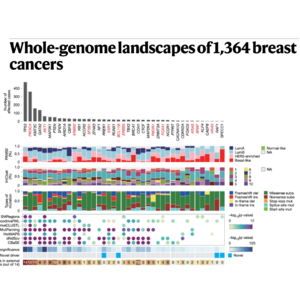
0The paper presents a comprehensive genomic analysis of 1,364 breast cancers from a Korean cohort (CUBRICS), integrating whole-genome sequencing (WGS) and clinical annotations to characterize the disease landscape. Key findings include the identification of novel driver genes, recurrent gene fusions, and structural variants, suggesting genomic instability emerges decades before tumor diagnosis. The study highlights the utility of WGS-derived features, such as mutational signatures (like those associated with Homologous Recombination Deficiency [HRD]) and tumor heterogeneity scores as potential predictive biomarkers for therapeutic responses to treatments like anti-HER2 and CDK4/6 inhibitors. Furthermore, the researchers investigate focal amplifications (e.g., ERBB2, CCND1, ZNF703) and their mechanisms, showing that absolute copy number, rather than the amplification method (like extrachromosomal DNA), better predicts treatment outcome in HER2-positive cases.
References:
- Kim R, Yu J, Lim J, et al. Whole-genome landscapes of 1,364 breast cancers[J]. Nature, 2025: 1-10.
