

 1
1 0
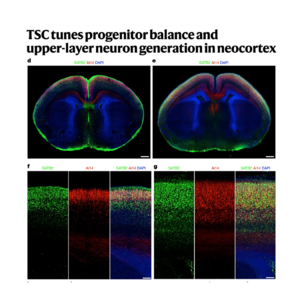
0The study details how the Tuberous Sclerosis Complex (TSC) proteins regulate the balance of progenitor cells, specifically radial progenitors (RG) and intermediate progenitors (IPs), during neocortex development. The research, primarily using mouse models (TSC1/2 cKO), demonstrates that the loss of TSC proteins shifts this balance toward an increase in IPs, leading to the overproduction and aberrant organization of upper-layer neurons, resulting in cortical expansion and malformations. Furthermore, the study suggests that the evolutionary suppression of TSC protein expression via human-gained enhancers (HGEs), particularly those regulating TSC2, may be a mechanism that facilitated the enhanced generation of neurons necessary for the evolution of the larger human brain. These findings connect the TSC pathway to fundamental mechanisms of cerebral cortex formation and neurodevelopmental disorders such as tuberous sclerosis complex and autism spectrum disorder (ASD).
References:
- Casingal C R, Nakagawa N, Yabuno-Nakagawa K, et al. TSC tunes progenitor balance and upper-layer neuron generation in neocortex[J]. Nature, 2025: 1-11.
