
 12
12 0
0Erinome: Hello dear friends! Welcome to today's podcast. Let's talk about some interesting news in China's catering industry. You know, there's a famous restaurant chain called Xibei. Recently, they had some big changes after a风波 (fengbo, that means "public opinion storm"). Let's see what's happening now!
Enceladus: Oh right! I remember hearing about Xibei before. So what's new with them?
Erinome: Well, January 1st, 2026 was a special day for Xibei. They've been around for 37 years, and this New Year was like a new start. You know, after the storm, they spent 113 days trying to fix things. They even gave out big subsidies, like "spend any amount get 100 yuan coupon" and "spend 50 return 50". But now, they stopped those subsidies.
Enceladus: Oh, subsidies stopped? Did that affect their customers? I thought people might go less if there's no discount.
Erinome: That's the interesting part! Reporters visited 5 Beijing stores, including the one where the storm started. And on January 3rd, Xibei said during New Year's Day, about 500,000 people went to their stores nationwide. The number of customers didn't drop even without subsidies! Wow, that's cool.
Enceladus: No way! So people still go even without discounts? Why?
Erinome: Let's look back. The storm started with a "complaint" about Xibei, but then it became a big debate for the whole industry. They talked about "fresh cooking vs pre-made food", "efficiency vs 烟火气 (yanhuoqi, that means 'the feeling of real cooking fire')", "transparency vs trust"... It made the whole catering industry think: how to balance industrialization, supply chain upgrade, and winning back customers' trust.
Enceladus: Oh right, pre-made food was a hot topic. So how did Xibei fix things?
Erinome: They did a lot! First, they changed how they make food. Like, core dishes are now made fresh in stores. For example, their lamb skewers—before, they were semi-finished from central kitchen, but now? They cut, string, and grill them right in the store, and you can see the chefs doing it! Their chicken soup is now slow-cooked: "start fire at 6 AM, stop at 10 PM". More 烟火气, right?
Enceladus: That sounds good! Fresh food tastes better. Did customers notice?
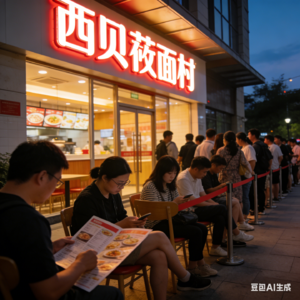
Erinome: Oh yes! Reporters saw in Beijing, many stores still had long lines during peak hours. Like, the Xiangyun Town store: on Jan 1st, 438 customers came, and lunch seats were 144.9% full! The manager said most customers are regulars—even the waiters know the kids who come often.
Enceladus: Regulars? That means people trust them again. What about other stores?
Erinome: The Wukesong Wanda store has 42 tables. On Dec 31st, 2025, they had 300 tables; Jan 1st, 361 tables! And the waiting time on Jan 1st was 40-50 minutes. Even after subsidies stopped, people still waited.
Enceladus: Sad for the waiting, but happy for Xibei! So why did customers come back? Just fresh food?
Erinome: Also prices! They cut prices a lot. Over 30 dishes got cheaper, almost 20% down. The average cost per person dropped from 92 yuan to 75 yuan. And the boss, Jia Guolong, promised: "These lower prices won't go up again. It's long-term."
Enceladus: Oh, that's a big promise! So from "expensive" to "good value"?
Erinome: Exactly! They changed their pricing logic. Before, maybe they set prices based on profit, but now? They listen to customers: "What do you think this dish is worth?" Then set the price, and cut costs inside to make profit. Smart, right?
Enceladus: Smart! And did they stop any old rules? Like, I heard some restaurants promise "serve food in 25 minutes" with a sand clock.
Erinome: Oh yes! Xibei stopped that. Because when you make food fresh, it takes longer. So they removed the "25-minute promise". And customers? They showed with actions: real fresh food is worth waiting for.
Enceladus: That makes sense. What else did they do for trust?
Erinome: Transparency! They now do "kitchen live streams". Every store has 6 cameras, so you can see how food is made. And they stopped putting tableware on tables before customers come—now, they only put clean, disinfected ones after you sit down.
Enceladus: Oh, that's safe! What about the 电磁炉 (diancilu, electric stove) problem? I heard people complained they used electric stoves instead of real fire.
Erinome: A store manager said, "Shopping malls don't allow open fire. Electric stoves are more stable and safe for customers." And Xibei's dishes are mostly stewed, so electric stoves don't hurt the taste. That makes sense.
Enceladus: So all these changes worked. Now, what's the industry learning from Xibei's story?
Erinome: The storm pushed three big improvements! First, it speeded up the national standard for pre-made food. Soon, pre-made food might need clear labels. Second, more restaurants are doing "transparency"—like live streams, QR codes to check where food comes from. Third, they learned to balance "standardization" and "烟火气". Standardization should save cost, not kill taste.
