

 0
0 0
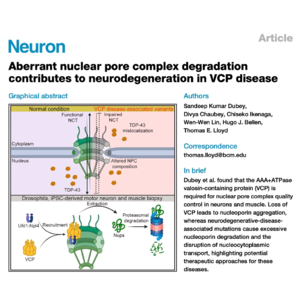
0This research identifies Valosin-containing protein (VCP) as a critical regulator of nuclear pore complex (NPC) integrity in neurons and muscle cells. Under healthy conditions, VCP uses the Ufd1-Npl4 cofactor to remove and degrade specific nucleoporins, maintaining cellular balance. However, pathogenic VCP mutations cause a toxic gain-of-function where the protein excessively strips these essential components from the nuclear envelope. This aggressive degradation leads to structural NPC defects, failing nucleocytoplasmic transport, and the mislocalization of the protein TDP-43. Consequently, these molecular failures drive the progressive neurodegeneration and muscle wasting characteristic of VCP-associated diseases. The study suggests that inhibiting VCP may offer a viable therapeutic pathway to restore transport function and protect motor neurons.
References:
- Dubey S K, Chaubey D, Ikenaga C, et al. Aberrant nuclear pore complex degradation contributes to neurodegeneration in VCP disease[J]. Neuron, 2025.
