

 0
0 0
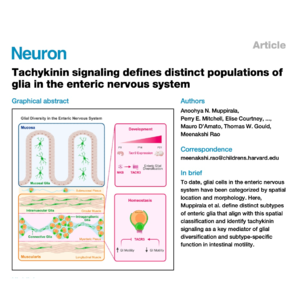
0This research identifies transcriptionally and functionally distinct subtypes of glia within the enteric nervous system (ENS), challenging the traditional view of these cells as a uniform population. By utilizing bulk and single-cell RNA sequencing, the authors mapped specific genetic signatures to the established spatial-morphological classifications of mucosal and muscularis glia. A central discovery is the NKB-TACR3 signaling axis, which uniquely identifies intraganglionic glia and serves as a critical regulator of intestinal motility and postnatal glial development. Experimental manipulation of this pathway demonstrated that tachykinin signaling acts as a physiological brake on gut transit, with significant implications for human conditions like constipation and diarrhea. Ultimately, the study provides a high-resolution molecular atlas of the ENS that clarifies how niche-specific glial identities are established and maintained.
References:
- Muppirala A N, Mitchell P E, Courtney E, et al. Tachykinin signaling defines distinct populations of glia in the enteric nervous system[J]. Neuron, 2026.
