

 0
0 0
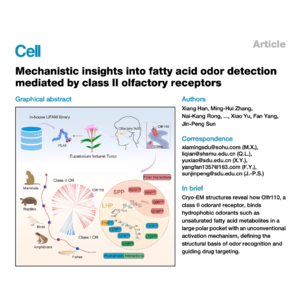
0This research article describes the structural basis and activation mechanism of class II olfactory receptors, specifically focusing on Olfr110. By utilizing cryo-electron microscopy, the authors identified a large, hydrophobic binding pocket that allows these receptors to detect unsaturated fatty acid metabolites like PL45 and 12(S)-HEPE. The study reveals a dual-pocket architecture and a specialized aromatic residue array that facilitates the recognition of complex, nonpolar odorants common in terrestrial environments. Furthermore, the findings highlight an unconventional activation pathway and unique G protein coupling compared to other receptor classes. These insights are significant because extranasal olfactory receptors play vital roles in metabolism and disease, potentially serving as future therapeutic targets. Overall, the work bridges a major gap in our understanding of how mammals perceive volatile hydrophobic molecules.
References:
- Han X, Zhang M H, Rong N K, et al. Mechanistic insights into fatty acid odor detection mediated by class II olfactory receptors[J]. Cell, 2026.
