

 1
1 0
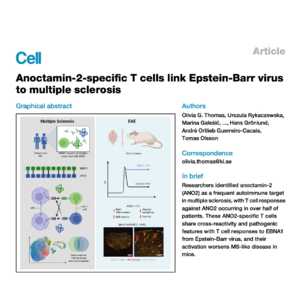
0This research investigates the immunological connection between the Epstein-Barr virus (EBV) and the development of multiple sclerosis (MS) through a mechanism known as molecular mimicry. Scientists discovered that immune cells initially targeting the EBV protein EBNA1 can mistakenly attack the brain protein anoctamin-2 (ANO2) because they share similar structural features. By utilizing single-cell sequencing and T cell receptor analysis, the study demonstrates that these cross-reactive T cells are prevalent in patients and possess highly cytotoxic phenotypes. Experimental models further show that priming the immune system with these specific antigens can worsen neurological damage and brain inflammation. Ultimately, the findings suggest that the interaction between viral triggers and genetic susceptibility, specifically the HLA-DRB1*15:01 allele, plays a critical role in driving the autoimmune response seen in MS.
References:
- Thomas O G, Rykaczewska U, Galešić M, et al. Anoctamin-2-specific T cells link Epstein-Barr virus to multiple sclerosis[J]. Cell, 2026.
