

 0
0 0
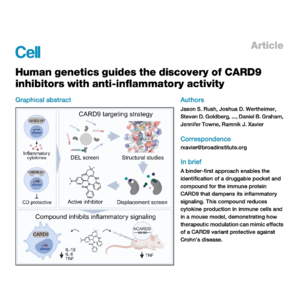
0This research article details the identification and development of small-molecule inhibitors targeting the CARD9 protein to treat inflammatory and autoimmune disorders. By leveraging human genetics, researchers discovered that while a total loss of CARD9 leads to immunodeficiency, partial loss-of-function variants provide protection against Crohn’s disease without compromising fungal immunity. Using DNA-encoded libraries and high-throughput screening, the team identified a benzodiazepine series that successfully disrupts CARD9 signaling and reduces the production of inflammatory cytokines. Structural analysis and X-ray crystallography confirmed that these compounds bind to a specific site on the protein, establishing a new therapeutic foothold for traditionally difficult drug targets. Functional studies in humanized mice and primary cells demonstrated that these inhibitors can effectively suppress systemic inflammation in vivo. This study concludes that precisely modulating CARD9 activity offers a promising, genetics-guided approach to treating immune-mediated diseases with improved safety.
References:
- Rush J S, Wertheimer J D, Goldberg S D, et al. Human genetics guides the discovery of CARD9 inhibitors with anti-inflammatory activity[J]. Cell, 2026.
