

 2
2 0
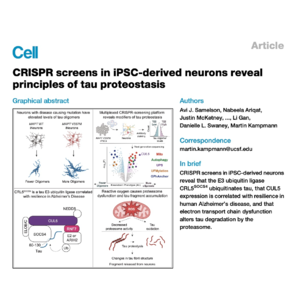
0This research paper details a large-scale CRISPR screening study conducted in human iPSC-derived neurons to identify genes that regulate tau protein levels and aggregation. The authors discovered that the CUL5-ARIH2 ubiquitin ligase complex plays a critical role in marking tau for degradation, while oxidative stress and mitochondrial dysfunction trigger the formation of a toxic 25-kDa tau fragment. Through biochemical analysis, they demonstrate that reactive oxygen species impair proteasome efficiency, leading to the accumulation of these fragments which are prone to forming tau oligomers. The study further connects these laboratory findings to human pathology by showing that CUL5 expression correlates with cellular resilience in patients with Alzheimer’s disease. Ultimately, the findings highlight the ubiquitin-proteasome system and antioxidant pathways as vital defense mechanisms against the protein misfolding characteristic of tauopathies.
References:
- Samelson AJ, Ariqat N, McKetney J, Rohanitazangi G, Bravo CP, Bose R, Travaglini KJ, Lam VL, Goodness D, Dixon G, Marzette E, Jin J, Tian R, Tse E, Abskharon R, Pan H, Carroll EC, Lawrence RE, Gestwicki JE, Eisenberg D, Kanaan NM, Southworth DR, Gross JD, Gan L, Swaney DL, Kampmann M. CRISPR screens in iPSC-derived neurons reveal principles of tau proteostasis. bioRxiv [Preprint]. 2024 Nov 4:2023.06.16.545386. doi: 10.1101/2023.06.16.545386. Update in: Cell. 2026 Jan 28:S0092-8674(25)01487-4. doi: 10.1016/j.cell.2025.12.038. PMID: 37398204; PMCID: PMC10312804.
