

 1
1 0
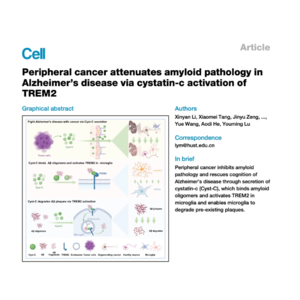
0This research explores the biological link between cancer and Alzheimer’s disease, investigating why cancer patients often exhibit a lower risk of neurodegeneration. By using 5×FAD mouse models, researchers discovered that peripheral tumors release specific secretory proteins that significantly reduce amyloid-beta accumulation and cognitive decline. Among these proteins, Cystatin-C (Cyst-C) was identified as a primary driver that crosses the blood-brain barrier to inhibit plaque formation. The study demonstrates that Cyst-C functions by binding to the TREM2 receptor on microglia, which triggers the immune clearance of pathogenic proteins. These findings suggest that tumor-derived factors could provide a foundation for developing new disease-modifying therapies for dementia. Ultimately, the work highlights a complex reciprocal interaction where cancer-related molecular pathways offer protective benefits against the hallmark pathologies of Alzheimer’s.
References:
- Li X, Tang X, Zeng J, et al. Peripheral cancer attenuates amyloid pathology in Alzheimer’s disease via cystatin-c activation of TREM2[J]. Cell, 2026.
