

 1
 0
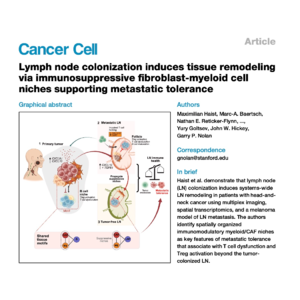
This research explores how cancer spreads to lymph nodes and actively reshapes the immune system to favor tumor growth. By utilizing high-dimensional spatial imaging and transcriptomics on human and mouse tissues, the authors demonstrate that lymph node colonization is not a passive event but a driver of systemic immunosuppression. The presence of tumor cells triggers the formation of suppressive cellular niches composed of specialized fibroblasts and myeloid cells that impair T cell function. These changes extend beyond the immediate tumor site, affecting distant, tumor-free lymph nodes and facilitating further metastatic progression. Ultimately, the study identifies specific molecular signals and spatial patterns that could serve as targets for future immunotherapies.
References:
- Haist M, Baertsch M A, Reticker-Flynn N E, et al. Lymph node colonization induces tissue remodeling via immunosuppressive fibroblast-myeloid cell niches supporting metastatic tolerance[J]. Cancer Cell, 2026.
