

 0
0 0
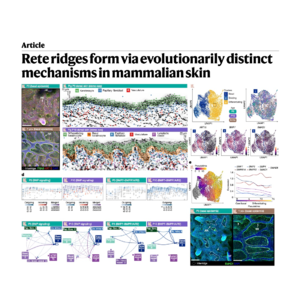
0This research identifies rete ridges as a unique type of mammalian skin appendage that develops through molecular pathways distinct from those governing hair follicles and sweat glands. By comparing various species, including humans, pigs, and dolphins, the study reveals that these ridges enable a significantly thicker epidermis, which likely evolved as a defensive adaptation in animals with reduced hair density. Unlike other skin structures that form during embryogenesis, rete ridges appear postnatally and are maintained by a specialized microenvironment known as a dermal pocket. Experimental data from mouse and pig models demonstrate that while traditional appendages rely on WNT and EDA signaling, rete ridge formation specifically requires broad activation of the BMP signaling pathway. These findings suggest that the presence of rete ridges is not tied to hair-loss genetics but is a de novo evolutionary acquisition driven by unique cellular interactions. Ultimately, understanding these mechanisms offers new possibilities for regenerating skin structures lost to aging, disease, or traumatic wounding.
References:
- Thompson S M, Yaple V S, Searle G H, et al. Rete ridges form via evolutionarily distinct mechanisms in mammalian skin[J]. Nature, 2026: 1-11.
