

 0
0 0
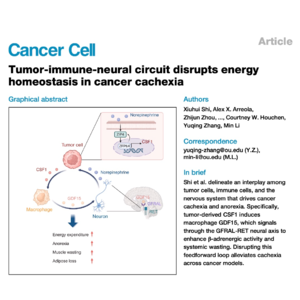
0This research identifies a tumor-immune-neural circuit that drives cancer cachexia, a syndrome characterized by severe muscle wasting, fat loss, and appetite suppression. The study demonstrates that tumor cells release CSF1 to recruit macrophages, which then produce the hormone GDF15. This hormone signals through the brain’s GFRAL-RET axis to activate the sympathetic nervous system, releasing norepinephrine that further stimulates tumor growth and wasting in a self-amplifying loop. Researchers found that deleting GDF15 or using pharmacological inhibitors against components like CSF1R or RET effectively reverses these metabolic disruptions in mouse models. Ultimately, the findings suggest that targeting this tripartite interaction between the cancer, immune cells, and nervous system offers a promising therapeutic strategy for treating cachexia in human patients.
References:
- Shi X, Arreola A X, Zhou Z, et al. Tumor-immune-neural circuit disrupts energy homeostasis in cancer cachexia[J]. Cancer Cell, 2026.
