

 1
1 0
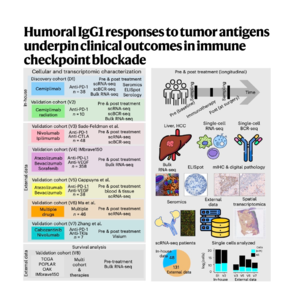
0This research highlights the essential role of humoral immunity in determining the success of immune checkpoint blockade (ICB) therapy across various cancers, particularly hepatocellular carcinoma. The study identifies that patients who respond well to treatment exhibit a significant expansion of IgG1-secreting plasma cells and specialized B cell niches within the tumor environment. These beneficial immune cells produce antibodies targeting cancer-testis antigens, a process that appears to coordinate with T cell activity to enhance anti-tumor responses. In contrast, non-responders tend to accumulate dysfunctional or memory B cells within immunosuppressive stromal regions that hinder effective immunity. By analyzing diverse clinical datasets, the authors demonstrate that a high IgG1 genetic signature strongly correlates with improved survival rates following immunotherapy. These findings suggest that monitoring and therapeutically promoting B cell differentiation into IgG1 plasma cells could serve as a powerful strategy for improving patient outcomes.
References:
- Gonzalez-Kozlova E, Sweeney R, Figueiredo I, et al. Humoral IgG1 responses to tumor antigens underpin clinical outcomes in immune checkpoint blockade[J]. Nature Medicine, 2026: 1-14.
