

 22
22 0
0Erinome:Hello dear friends! Welcome to today's news talk. I'm Erinome, and with me is Enceladus. Let's see what important news we have today. Did you hear about the birth population in China for 2026? It's really surprising.
Enceladus:Oh wow, what's the number? I haven't checked the news yet.
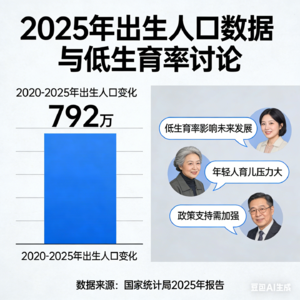
Erinome:It's 7.92 million. Can you believe that? It's the first time since the founding of New China that the birth population has dropped below 8 million. And here's a more shocking part: the total birth population of developed countries in the US and Europe has surpassed ours for the first time.
Enceladus:Oh no, that's sad. I remember older people talking about the "baby boom" in the 80s and 90s. Hospitals were full, and primary school classes had over 50 students. Now it's like the clock has turned back to the lowest point.
Erinome:Right! And the total population also dropped below 1.4 billion last year, a decrease of over 3 million from the year before. It's been falling for 4 years, like a steep slope—hard to stop. Why do people not want to have babies now?
Enceladus:Um, maybe because it's too expensive to raise a child. I heard in first-tier cities, the cost from milk powder to university is over a million yuan. Housing loans, education, medical care—these three big mountains are pressing on young people. They can barely support themselves, how can they think about "more children, more happiness"?
Erinome:You know that? The fertility rate is even more worrying. In 2020, it was 1.3, but last year it dropped below the warning line. It's lower than the EU's 1.4 and America's 1.6. Experts say if the fertility rate is below 1.5, we enter the "low fertility trap". And we're getting deeper into it.
Enceladus:That's not just a future problem. It's happening now! If people don't have babies now, in 20 years there will be half as many workers. Nursing homes will be full, kindergartens will close, and even square dancing groups won't have enough people. So sad.
Erinome:Let's talk about the impact of the population dividend fading. In the past, we relied on "human wave tactics" to be the world's factory. Young people supported the assembly lines, and new generations supported consumption. But now, with fewer young people, the first to suffer is the demand side.
Enceladus:Right! Half of the baby stores have closed, school district housing prices have dropped, and car sales have fallen for three years in a row. It's not that people don't want to buy, but there are fewer people to buy.
Erinome:The domestic market is our "golden sign". China can be the "supply chain leader" because of the "super market of over a billion people". Huawei phones and BYD cars rose because of hundreds of millions of domestic consumers. Even Tesla and Apple moved factories here for this big customer base.
Enceladus:But if the population keeps falling, domestic demand will shrink. Companies have to find markets abroad. But external sanctions are getting tighter. If foreign markets are blocked, companies without a domestic market to rely on are like kites with broken strings. Iran and Venezuela are examples—small markets, and they get hurt badly by sanctions. If we lose our "super market", our global voice will get weaker.
Erinome:Some people say "AI and robots can replace labor". But even smart AI won't buy milk powder, choose school district housing, or buy health products for parents. Consumers are the "engine" of the economy. Without real demand from new families, factories will just have stockpiles.
Enceladus:Exactly! The past 30 years of industrial upgrading, from home appliances to new energy cars, relied on "generations of consumers willing to try new things". Now the "baby army" is getting smaller. Companies can't even find directions for innovation—no users to "test mistakes", how to upgrade?
Erinome:So, can government subsidies save the fertility rate? Local governments are in a hurry: some give 100,000 yuan for a third child, extend maternity leave to a year, offer housing discounts and tax cuts. The national "15th Five-Year Plan" is testing a four-day workweek and building more affordable housing to help young people. Do these work?
Enceladus:Hmm, maybe they can make the numbers jump a little in the short term, but not solve the root problem. Young people don't dare to have babies not because they lack a few thousand yuan in subsidies. They're afraid "they can't raise the child well, and can't educate them well".
Erinome:Right! Milk powder needs to be imported, kindergartens need to be bilingual, school district housing is天价, and parents need money for old age. These "rigid expenses" are like a big mountain. The subsidies can't even cover the interest. What young people really need is "certainty": affordable childcare when the baby is born, no need to fight for school spots, no need to empty savings when sick, and security in old age.
