

 1
1 0
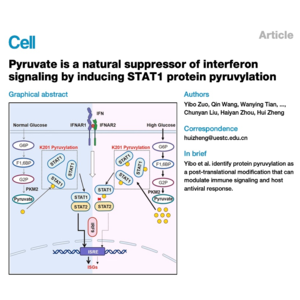
0This research identifies protein pyruvylation as a novel post-translational modification where the metabolite pyruvate covalently attaches to the STAT1 protein. The study demonstrates that high glucose levels accelerate this process, specifically modifying STAT1 at the Lys201 residue and preventing it from binding with STAT2. This molecular blockage effectively suppresses type I interferon (IFN-I) signaling, which is a critical component of the body's antiviral immune response. Through experiments with STAT1-K201R knockin mice, researchers proved that preventing this modification enhances immunity against viral infections. Ultimately, these findings explain how hyperglycemia and metabolic shifts impair the immune system, offering new therapeutic targets for treating viral diseases in diabetic patients.
References:
- Zuo Y, Wang Q, Tian W, et al. Pyruvate is a natural suppressor of interferon signaling by inducing STAT1 protein pyruvylation[J]. Cell, 2026.
