

 0
0 0
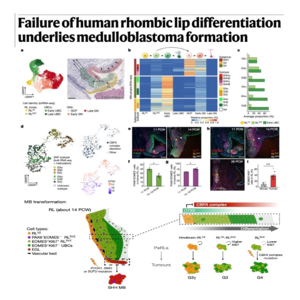
0This research investigates the cellular origins of medulloblastoma, a common childhood brain cancer, focusing specifically on the Group 3 and Group 4 subtypes. The study identifies that these tumors arise from a failure in the normal development of the human rhombic lip, a structure that expands significantly more in humans than in other species. Genetic analysis reveals that mutations often disrupt the CBFA complex, which is essential for the proper maturation of neural progenitor cells. When these proteins fail to function or when the gene OTX2 is overexpressed, cells become trapped in a primitive, proliferative state. This developmental stall results in the formation of premalignant remnants in the cerebellum that eventually progress into aggressive tumors. Ultimately, the authors suggest that the very evolutionary traits that allowed for human brain expansion also created a unique biological vulnerability to these specific cancers.
References:
- Hendrikse L D, Haldipur P, Saulnier O, et al. Failure of human rhombic lip differentiation underlies medulloblastoma formation[J]. Nature, 2022, 609(7929): 1021-1028.
