

 1
 0
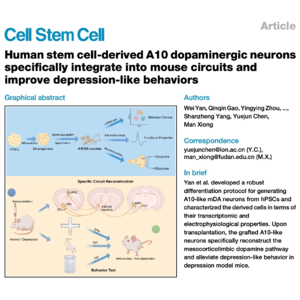
This research article introduces a novel differentiation protocol designed to generate A10-like midbrain dopaminergic neurons from human pluripotent stem cells. The authors discovered that inhibiting Notch signaling during a specific post-mitotic stage effectively drives the specification of the A10 subtype, which is typically associated with the ventral tegmental area. When transplanted into mice, these derived neurons successfully reconstructed the mesocorticolimbic dopamine pathway and demonstrated functional integration into host circuits. Remarkably, the activation of these grafted cells was found to alleviate depression-like behaviors and anhedonia in animal models. The study serves as a proof-of-concept for using subtype-specific cell therapies to treat neuropsychiatric disorders by repairing dysfunctional neural networks. These findings highlight the potential for human stem cell-derived neurons to restore complex emotional and cognitive functions beyond traditional motor-related applications.
References:
- Yan W, Gao Q, Zhou Y, et al. Human stem cell-derived A10 dopaminergic neurons specifically integrate into mouse circuits and improve depression-like behaviors[J]. Cell Stem Cell, 2025, 32(9): 1457-1474. e7.
