

 0
0 0
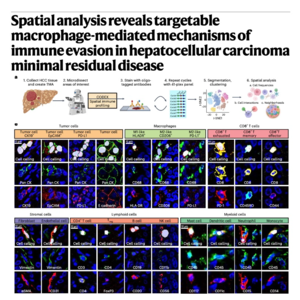
0This research investigates how hepatocellular carcinoma (HCC) persists as minimal residual disease following treatment and eventually causes cancer recurrence. By utilizing spatial analysis and high-resolution imaging on human samples and mouse models, the authors identified a specific neighborhood of cells where immunosuppressive macrophages interact with stem-like tumor cells. These interactions are driven by the TGFβ pathway, which allows cancer cells to evade the immune system and leads to the exhaustion of protective CD8+ T cells. The study demonstrates that dual-targeting of the PD-L1 and TGFβ pathways can successfully eliminate these residual cells in mice. Ultimately, these findings suggest a new therapeutic strategy to prevent liver cancer from returning by disrupting the local environment that sustains dormant tumor cells.
References:
- Lemaitre L, Adeniji N, Suresh A, et al. Spatial analysis reveals targetable macrophage-mediated mechanisms of immune evasion in hepatocellular carcinoma minimal residual disease[J]. Nature cancer, 2024, 5(10): 1534-1556.
