

 1
1 0
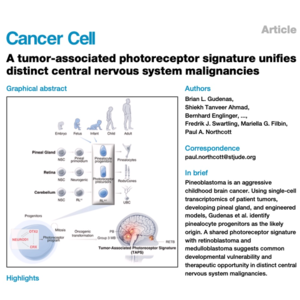
0This research identifies pinealocyte progenitors as the specific developmental origin of pineoblastoma, a dangerous pediatric brain cancer. By mapping the genetic landscape of human tumors and creating genetically engineered mouse models, scientists discovered that these malignancies arise during a specific window of high cellular growth. The study reveals a Tumor-Associated Photoreceptor Signature (TAPS) that is molecularly shared between pineoblastoma, retinoblastoma, and Group 3 medulloblastoma. This common signature suggests that these anatomically different tumors exploit the same developmental vulnerabilities to sustain their growth. Crucially, the researchers identified certain master regulatory genes as selective dependencies, meaning the cancer cells rely on them to survive. These findings offer a new framework for understanding rare childhood cancers and point toward therapeutic targets that could treat multiple types of brain and eye tumors.
References:
- Gudenas B L, Ahmad S T, Englinger B, et al. A tumor-associated photoreceptor signature unifies distinct central nervous system malignancies[J]. Cancer Cell, 2026.
