

 0
0 0
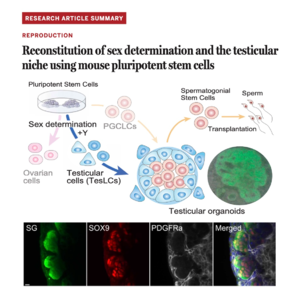
0Scientists have successfully developed a method to reconstitute the testicular environment using only mouse pluripotent stem cells, bypassing the need for embryonic tissue. By manipulating specific signaling pathways, researchers guided these stem cells through a bipotential gonadal state into functional testicular somatic cell-like cells (TesLCs). When combined with primordial germ cell-like cells, these induced tissues formed testicular organoids that supported the development of spermatogonial stem cells. These laboratory-grown stem cells were capable of producing mature sperm after transplantation into mice, eventually leading to the birth of healthy, fertile offspring. The study also highlights a fundamental asymmetry in sex determination, demonstrating that while male differentiation strictly requires a Y chromosome, male cells can still be induced to support female egg development. This breakthrough provides a sophisticated platform for studying reproductive biology and advancing in vitro gametogenesis across various species.
References:
- Yoshino T, Sasada H, Sato T, et al. Reconstitution of sex determination and the testicular niche using mouse pluripotent stem cells[J]. Science, 2026, 391(6788): eaea0296.
