

 0
0 0
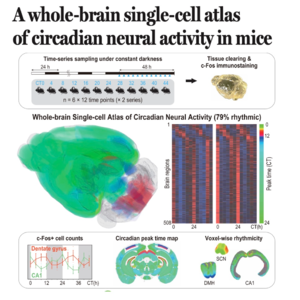
0Researchers have developed a comprehensive single-cell atlas of the mouse brain to map how neural activity changes across the 24-hour circadian cycle. By using advanced tissue clearing and 3D imaging techniques on 144 brains, the study identified that nearly 80% of brain regions exhibit significant rhythmic patterns under constant darkness. The data reveals that while many areas peak during the animal's active night phase, others, such as those governing sleep and vision, activate during the day. This research highlights the spatiotemporal coordination of the entire brain, showing how different subregions specialize their activity based on time. To support future neuroscience and pharmacological studies, the authors provided an open-access database for exploring these global rhythms. This resource establishes a vital temporal framework for understanding both healthy brain function and the dynamics of neurological diseases.
References:
- Yamashita K, Kinoshita F L, Yoshida S Y, et al. A whole-brain single-cell atlas of circadian neural activity in mice[J]. Science, 2025: eaea3381.
