

 3
3 0
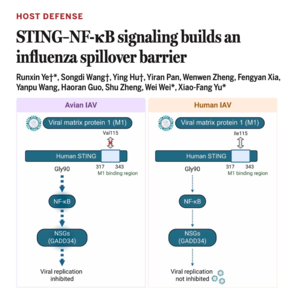
0This research identifies the STING–NF-κB–GADD34 signaling pathway as a critical innate immune barrier that restricts the transmission of avian influenza A viruses into humans. While the STING protein is well-known for triggering interferons, this study reveals that it also activates an IRF3-independent antiviral response through a specific Gly90 residue. This activation induces the expression of GADD34, which directly binds to and inhibits the viral polymerase complex to block replication. To counter this defense, human-adapted influenza strains have evolved a specific isoleucine mutation at position 115 of the M1 protein. This mutation allows the virus to evade human immune detection, whereas avian strains lacking this adaptation remain restricted. Consequently, monitoring the M1-115 variant provides a vital molecular marker for predicting the spillover risk of emerging pandemic threats.
References:
- Ye R, Wang S, Hu Y, et al. STING–NF-κB signaling builds an influenza spillover barrier[J]. Science, 2026, 391(6788): eads4405.
