

 0
0 0
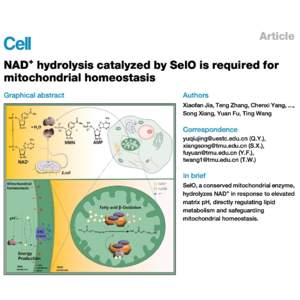
0This research identifies SelO as a conserved mitochondrial enzyme that regulates energy metabolism by hydrolyzing NAD+ into NMN and AMP. Using structural analysis of the bacterial homolog ydiU, scientists discovered that this activity is driven by a unique C-terminal selenocysteine residue and is triggered by increases in mitochondrial pH. The study demonstrates that SelO directly associates with fatty acid oxidation enzymes, effectively acting as a metabolic brake to prevent overactivation. In mice, the absence of this enzyme leads to elevated mitochondrial NAD+ levels and increased lipid utilization, but ultimately results in mitochondrial fragmentation and liver injury. These findings reveal that SelO is a critical protective factor that maintains organelle homeostasis by precisely controlling the spatiotemporal availability of NAD+.
References:
- Jia X, Zhang T, Yang C, et al. NAD+ hydrolysis catalyzed by SelO is required for mitochondrial homeostasis[J]. Cell, 2026.
