

 0
0 0
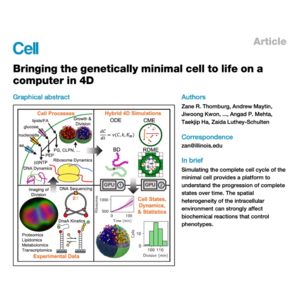
0This research presents a 4D whole-cell model of the genetically minimal bacterium JCVI-syn3A, simulating its complete 100-minute cell cycle on a computer. By integrating hybrid computational methods like stochastic kinetics and Brownian dynamics, the authors track the spatial and temporal evolution of genetic processes, metabolism, and physical growth. The simulation accurately replicates experimental data, including doubling times, ribosome counts, and the symmetric division observed in fluorescence imaging. A key focus is the spatial heterogeneity of the intracellular environment and how it influences biochemical reactions and physical morphology. Ultimately, this work provides a comprehensive platform for understanding the foundational rules of life through a bottom-up, physics-based approach.
References:
- Thornburg Z R, Maytin A, Kwon J, et al. Bringing the genetically minimal cell to life on a computer in 4D[J]. Cell, 2025.
