

 1
1 0
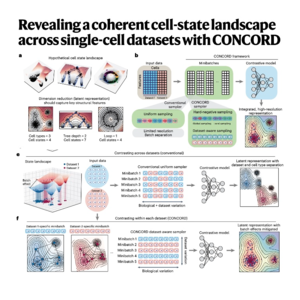
0The paper introduces CONCORD, a novel self-supervised learning framework designed to improve the analysis of single-cell sequencing data. Unlike traditional methods that struggle with technical noise and "batch effects," this model uses a probabilistic sampling strategy to generate high-fidelity biological representations. By prioritizing hard-negative and dataset-aware sampling, CONCORD effectively distinguishes subtle cellular states while integrating data across different technologies and species. The research demonstrates that this minimalist neural network outperforms complex deep-learning architectures in preserving topological structures like developmental trajectories and cell-cycle loops. Ultimately, the authors position CONCORD as a general-purpose tool for creating denoised, high-resolution cell atlases essential for studying health and disease.
References:
- Zhu Q, Jiang Z, Zuckerman B, et al. Revealing a coherent cell-state landscape across single-cell datasets with CONCORD[J]. Nature Biotechnology, 2026: 1-15.
