

 1
1 0
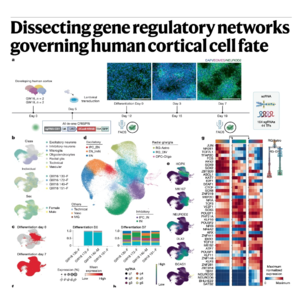
0This research established a primary culture system to study the gene regulatory networks that control how human radial glia stem cells develop into various brain cells. By utilizing single-cell CRISPR interference (CRISPRi) screening and lineage tracing, the authors examined the functional roles of 44 transcription factors active during cortical neurogenesis. The study identified ZNF219 as a novel repressor of neural differentiation and revealed that NR2E1 and ARX play opposing roles in managing the timing and balance of excitatory versus inhibitory neuron production. Furthermore, the researchers discovered convergent effector genes that are linked to neuropsychiatric disorders, suggesting these genes act as critical hubs in brain development. These findings, which were also validated in rhesus macaques, provide a comprehensive framework for understanding the molecular mechanisms and evolutionary conservation of primate cortical development.
References:
- Ding J W, Kim C N, Ostrowski M S, et al. Dissecting gene regulatory networks governing human cortical cell fate[J]. Nature, 2026: 1-11.
