

 0
0 0
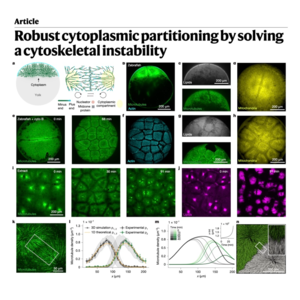
0This research explores how early embryos of different species, such as zebrafish and fruit flies, manage to organize their internal fluid into distinct cells. Scientists discovered an inherent physical instability in the microtubule networks that act as scaffolds for these cellular boundaries, which should theoretically cause the structures to collapse or merge. The study reveals that biological systems overcome this instability by either limiting microtubule growth or precisely timing the cell cycle to complete division before the structures can break down. By comparing different organisms, the authors show that these evolutionary strategies ensure the rapid and robust development of a fertilized egg into a complex multicellular being. These findings highlight a fundamental synergy between biochemical clocks and the physical laws governing spatial organization in living matter.
References:
- Rinaldin M, Kickuth A, Lamson A, et al. Robust cytoplasmic partitioning by solving a cytoskeletal instability[J]. Nature, 2026: 1-10.
