
 4
4 0
0Title:
Enzyme Specificity Unlocked : The EZSCAN Advantage
Astract:
Identifying amino acid residues critical for determining substrate and cofactor specificity is essential for understanding enzyme mechanisms and guiding protein engineering. Current methods struggle to distinguish these residues from those merely maintaining structural stability. The research team developed a computational approach to identify residues influencing specificity among structurally homologous enzymes by framing sequence comparison as a classification problem—an innovation that enabled the objective identification of key functional differences. This method was validated using four pairs of enzymes and accurately predicted known specificity-determining residues. Experimental validation further demonstrated that introducing the predicted key substitutions could successfully alter substrate and cofactor specificity while preserving protein expression levels, highlighting the method’s robust effectiveness. The team has since implemented this approach as a practical web tool, EZSCAN (Enzyme Substrate-specificity and Conservation Analysis Navigator), designed for the rapid identification of functionally critical amino acid residues in enzymes.
Personal Profile:
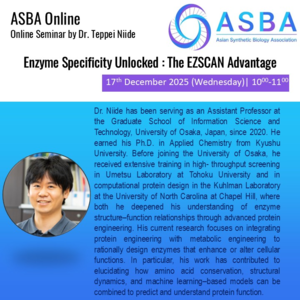
Dr. Niide has been serving as an Assistant Professor at the Graduate School of Information Science and Technology, University of Osaka, Japan, since 2020. He earned his Ph.D. in Applied Chemistry from Kyushu University. Before joining the University of Osaka, he received extensive training in high- throughput screening in Umetsu Laboratory at Tohoku University and in computational protein design in the Kuhlman Laboratory at the University of North Carolina at Chapel Hill, where both he deepened his understanding of enzyme structure–function relationships through advanced protein engineering. His current research focuses on integrating protein engineering with metabolic engineering to rationally design enzymes that enhance or alter cellular functions. In particular, his work has contributed to elucidating how amino acid conservation, structural dynamics, and machine learning–based models can be combined to predict and understand protein function.
