
 0
0 0
0Title:
From Empirical Tuning to Platform Design: CRISPR Screening–Enabled
Mammalian Cell Engineering
Astract:
The expanding diversity of complex biotherapeutics (e.g., bispecific antibodies, hard-to-express proteins) exposes inherent limitations of empirically optimized mammalian cell factories. While CHO cell-based monoclonal antibody production is mature, next-generation biologic manufacturing is hindered by poorly characterized modality-specific bottlenecks. Leveraging advances in mammalian synthetic biology and genome editing, genome-wide CRISPR screening has become an unbiased tool for systematic cell engineering. This presentation introduces a virus-free, RMCE-based CRISPR screening platform for scalable knockout/activation screens in CHO cells; integrating productivity-, stress- and FACS-based selection, the platform identifies novel genetic and epigenetic targets regulating cell fitness, stress tolerance and transgene expression. Combining CRISPR-driven target discovery with precise knock-in gene expression control provides a rational framework for platform-level mammalian cell factory design, shifting cell engineering from empirical tuning to predictive, modality-adaptive platforms for next-generation biotherapeutics manufacturing.
Personal Profile:
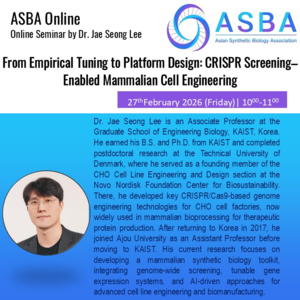
Dr. Jae Seong Lee is an Associate Professor at the Graduate School of Engineering Biology, KAIST, Korea. He earned his B.S. and Ph.D. from KAIST and completed postdoctoral research at the Technical University of Denmark, where he served as a founding member of the CHO Cell Line Engineering and Design section at the Novo Nordisk Foundation Center for Biosustainability. There, he developed key CRISPR/Cas9-based genome engineering technologies for CHO cell factories, now widely used in mammalian bioprocessing for therapeutic protein production. After returning to Korea in 2017, he joined Ajou University as an Assistant Professor before moving to KAIST. His current research focuses on developing a mammalian synthetic biology toolkit, integrating genome-wide screening, tunable gene expression systems, and AI-driven approaches for advanced cell line engineering and biomanufacturing.
