

 0
0 0
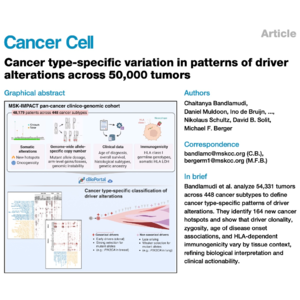
0The paper details the MSK-50K cohort, a massive clinico-genomic study analyzing over 54,000 tumors across 448 cancer subtypes to map tissue-specific driver alterations. Researchers identified 164 new cancer hotspots and discovered that one-third of drivers occur in non-canonical contexts, often displaying unique biological features like increased subclonality and later emergence. The study highlights how tissue type and clinical context—including age of onset and genetic ancestry—influence the functional roles of mutations. By examining clonality, zygosity, and co-mutation patterns, the authors refine the interpretation of genomic data to improve clinical actionability. Finally, the research addresses how ancestry-associated HLA genotypes and somatic loss shape eligibility for modern T cell receptor therapies.
References:
- Bandlamudi C, Muldoon D, de Bruijn I, et al. Cancer type-specific variation in patterns of driver alterations across 50,000 tumors[J]. Cancer Cell, 2026.
