

 1
1 0
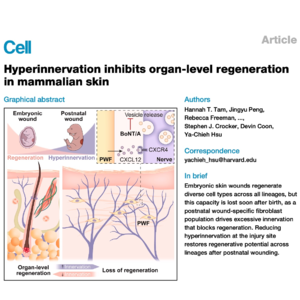
0This article identifies a critical developmental shift in mammalian skin where the ability to achieve organ-level regeneration is lost shortly after birth. While embryonic wounds can fully restore complex structures like hair follicles and sweat glands, postnatal injuries typically result in scarring and a failure to regenerate diverse cell lineages. The study discovers that postnatal wound-specific fibroblasts (PWFs) drive an abnormal increase in nerve density, termed hyperinnervation, which acts as a fundamental barrier to the healing process. By secreting the factor CXCL12, these fibroblasts recruit excessive sensory nerves to the injury site, effectively blocking the signals required for multi-lineage repair. Remarkably, the authors demonstrate that reducing hyperinnervation or inhibiting neuronal vesicle release can unlock the skin's latent potential, allowing postnatal tissue to regenerate with embryonic-like efficiency. This discovery provides a new framework for regenerative medicine, suggesting that targeting the nervous system's interaction with the wound bed can restore lost functionality in adult skin.
References:
- Tam H T, Peng J, Freeman R, et al. Hyperinnervation inhibits organ-level regeneration in mammalian skin[J]. Cell, 2026.
