

 0
0 0
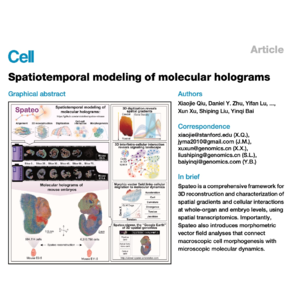
0The paper introduce Spateo, a versatile computational framework designed for the 3D spatiotemporal modeling of various spatial transcriptomics datasets. By applying this toolkit to a massive atlas of mouse and Drosophila embryos, researchers can reconstruct "molecular holograms" that capture millions of cells in their precise physical context. The software features advanced algorithms for non-rigid alignment, 3D digitization of complex structures, and the mapping of cell-cell interactions across organ-scale distances. A key innovation is the creation of morphic vector fields, which allow scientists to predict cellular migration paths and link macroscopic physical changes to microscopic gene expression. To facilitate widespread use, the authors also launched Spateo-viewer, an interactive web-based browser that functions like a "Google Earth" for navigating high-resolution genomic landscapes. Ultimately, this framework enables a transition from cell-centric analysis to a holistic understanding of tissue and organ ecology during development.
References:
- Qiu X, Zhu D Y, Lu Y, et al. Spatiotemporal modeling of molecular holograms[J]. Cell, 2024, 187(26): 7351-7373. e61.
