

 0
0 0
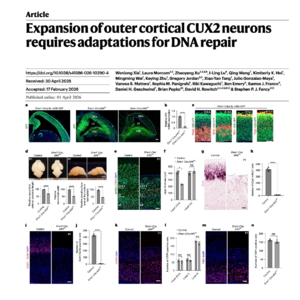
0This paper explores how the protein ATF4 serves as a vital protector of genome stability during the development of the mammalian brain. The study identifies that CUX2+ neurons, which occupy the upper layers of the cerebral cortex, are uniquely dependent on this factor to manage the stress of rapid cell replication. By utilizing conditional-knockout mice, the authors demonstrate that a lack of ATF4 leads to catastrophic DNA damage and widespread cell death specifically within these upper-layer neurons. While deeper cortical layers remain relatively unaffected, the absence of this protein results in a significantly thinned neocortex and the nearly total loss of CUX2+ excitatory cells. Mechanistically, ATF4 is shown to regulate the DNA damage response by activating essential repair components that ensure the proper function of the ATM signaling pathway. Ultimately, these findings reveal an evolutionary adaptation required to maintain the complex neural architecture associated with higher cognitive functions.
References:
- Xia W, Morcom L, Xu Z, et al. Expansion of outer cortical CUX2 neurons requires adaptations for DNA repair[J]. Nature, 2026: 1-12.
