

 0
0 0
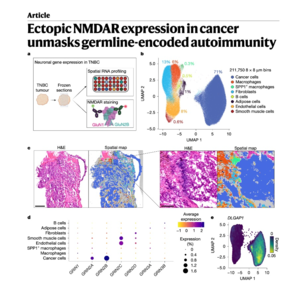
0This research establishes a mechanical link between triple-negative breast cancer (TNBC) and the autoimmune condition anti-NMDA receptor (ANRE) encephalitis. The study demonstrates that when tumors ectopically express NMDAR subunits, they trigger a robust adaptive immune response where germline-encoded B cells undergo affinity maturation to produce high-affinity autoantibodies. While these antibodies can successfully constrain tumor growth, they also cross the blood-brain barrier to interfere with neuronal signaling. Structural analysis via cryo-EM reveals that different matured antibodies can either inhibit or strongly potentiate receptor activity. Notably, the passive transfer of potentiating antibodies into healthy mice was sufficient to induce hallmark symptoms of ANRE, such as seizures and autonomic dysregulation. These findings suggest a critical evolutionary trade-off where the body’s attempt to surveil and destroy cancer cells inadvertently unmasks a germline-encoded path to severe neurotoxicity.
References:
- Kleeman S O, Michalski K, Zhao X, et al. Ectopic NMDAR expression in cancer unmasks germline-encoded autoimmunity[J]. Nature, 2026: 1-13.
