

 5
5 0
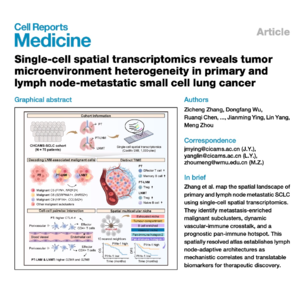
0This research presents a detailed spatial transcriptomic atlas of small cell lung cancer (SCLC) to identify how the tumor microenvironment evolves during lymph node metastasis. By examining over 600,000 individual cells from 75 patients, the study identifies three specific malignant subclusters that appear during metastasis and exhibit unique metabolic and immune-evading properties. The authors describe a dynamic vascular-immune crosstalk, noting that immune cells within the vascular niche are functionally reprogrammed to become more cytotoxic as the disease spreads. Through cellular neighborhood analysis, the researchers characterized distinct multicellular structures, such as the pan-immune hotspot (PIHs-1), which serves as a significant predictor of patient survival. Ultimately, these findings reveal how the spatial organization of cancer and immune cells contributes to tumor progression and provides new prognostic biomarkers for clinical use. These insights offer a high-resolution map of the biological architectures that facilitate SCLC growth and adaptation within the lymphatic system.
References:
- Zhang Z, Wu D, Chen R, et al. Single-cell spatial transcriptomics reveals tumor microenvironment heterogeneity in primary and lymph node-metastatic small cell lung cancer[J]. Cell Reports Medicine, 2026.
