

 0
0 0
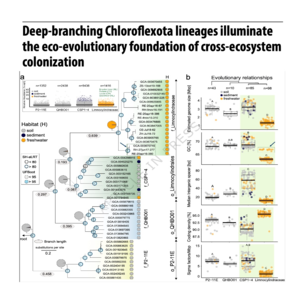
0Bacteria span Earth’s ecosystems, coupling ecological versatility with genome-architectural reconfiguration across shifting physicochemical conditions. Yet the genomic routes by which free-living lineages cross ecosystem boundaries, and the consequences for genome architecture, remain poorly understood. Here, we use comparative and evolutionary genomics to investigate a soil-to-sediment-to-freshwater transition in Limnocylindria, an abundant clade within the Chloroflexota phylum. Two sister families show contrasting strategies. CSP1-4 expands genomes through niche-specific gene acquisition, whereas Limnocylindraceae undergoes genome reduction and metabolic simplification—revealing alternative evolutionary routes to similar ecological outcomes. In Limnocylindraceae, the loss of key DNA glycosylases coincides with degradation of base excision repair and is consistent with a hypermutator state that may have accelerated genomic erosion during freshwater specialization, potentially facilitating ecological expansion. This reductive genome trajectory is associated with a freshwater-adapted lineage with unexpectedly high GC content, challenging canonical links between base composition and genome size. While mutational processes appear to dominate genome restructuring, proteome-level patterns suggest selection favoring carbon- and nitrogen-efficient amino acid usage, implying that adaptive refinement can emerge alongside primarily non-adaptive dynamics. Overall, our findings are consistent with mutation-driven genome reduction and proteome optimization acting in concert to support cross-ecosystem boundary crossing and freshwater specialization in a free-living Chloroflexota lineage.
References:
- Serra Moncadas L, Shakurova A, Hofer C, et al. Deep-branching Chloroflexota lineages illuminate the eco-evolutionary foundation of cross-ecosystem colonization[J]. Nature Communications, 2026.
